


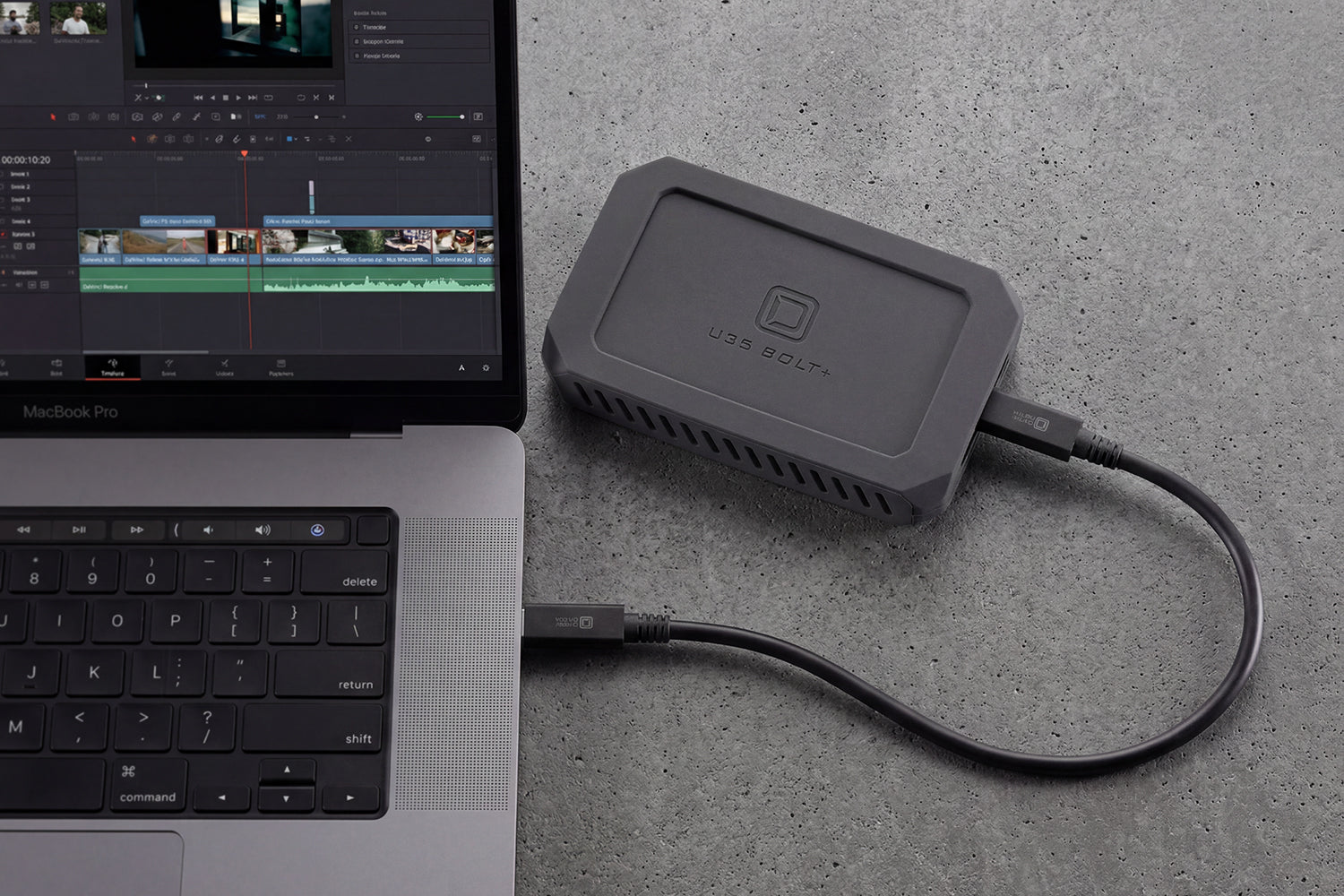
On paper, most SSDs look the same. Manufacturers advertise similar speeds, use the same interfaces, and often share the same underlying NAND. But anyone who has offloaded cards on set or pushed through a long transfer knows that two drives that look identical in specs can behave very differently in practice. The reason is simple: peak performance is easy to advertise, but sustained performance is significantly harder to engineer.
Many SSDs are designed to appear fast in short bursts. They rely heavily on SLC caching, which temporarily treats a portion of the NAND as high-speed memory. During the initial phase of a transfer, this works well and speeds can look impressive. However, once the cache fills, the drive must begin folding data back into its native format, typically TLC (Triple Layer Cell NAND) or QLC (Quad Layer Cell NAND). That process takes time and resources, which can result in write speeds dropping—sometimes drastically. Add heat buildup and background operations such as garbage collection, and the performance becomes inconsistent. Oftentimes, this can be why a drive that benchmarks well for 10-30 seconds or in short bursts will also struggle during a full card offload or an extended write from a camera.

This is illustrated when testing an SSD using Blackmagic Disk Speed Test. When using small file sizes between 1GB and 5GB, the SSD performs well with fast burst speeds. But that’s expected. It’s a short duration, an empty drive, and there is an abundance of cache. This type of test is sufficient for most users. However, many individuals do not execute adequate test durations to see how long-term performance is affected and how that can affect their workflow.
This distinction becomes critical in film and video workflows because the nature of the data is fundamentally different from typical desktop use. Cameras don’t write small, random files. They generate large, continuous, predictable streams of data. Whether you're recording directly to an SSD or offloading media on set, the workload is sustained and sequential. In that environment, what matters most is not how fast a drive starts, but how reliably it performs once it settles into steady-state operation.
Like spinning disks, SSDs can also slow down as they fill up. Think of a warehouse with rows and rows of shelves. When most of the shelves are full, it takes more time for the workers to identify the empty spots and get the boxes to the few remaining spots on the shelves. When the shelves are empty, this can happen very quickly. Similarly with SSDs and HDDs, when the “Shelves” are full, it takes more time to find the free space, thus slowing down the overall operation.
That steady-state performance is determined by the architecture of the SSD, not just its advertised specifications. The controller plays a central role, acting as the brain that manages how data is written, moved, and maintained over time. A well-designed controller, paired with carefully fine-tuned firmware, ensures that operations such as cache folding and garbage collection occur efficiently and without disrupting throughput. Firmware decisions—when to use cache, when to clean up data, and how aggressively to manage thermals—can dramatically impact whether a drive feels stable or unpredictable under heavy loads.
Sustained data rates should be tested and seen over large transfers. In your workflow, how much content are you shooting? What size camera cards are you using? If it’s 500GB or more, you need to test your SSDs based on that. That is how you can see if your SSDs will hold up to the demands of your workflow.
Notice the speed of the U35 BOLT+ 4TB over the course of a 1TB transfer (in the image), it was able to maintain 6 GB/s (6000 MB/s) during this write process. As a professional, these are things to test for and consider when selecting the appropriate SSD for your workflow.
NAND Parallelism
Another key factor to examine is NAND parallelism. SSDs are built from multiple NAND dies, and the ability to write to many of them simultaneously is what enables true sustained speed. Drives with greater internal parallelism can maintain higher throughput long after the cache has been exhausted. This is where real performance comes from during long transfers, not from temporary buffers. This is why larger capacities typically can see greater speeds. There are more NAND dies to write to, so it speeds up the overall operation of the SSD.

It’s important to note that this is different from the NAND layer count you see in marketing (for example, 176-layer or 232-layer 3D NAND). Layer count mainly tells you how dense each die is, not how many dies the controller can access in parallel. More layers typically improve density and cost, and newer generations can be faster, but sustained speed still depends more on controller design, firmware, and how much flash the SSD can hit in parallel.
For External SSDs, these specs are not advertised often, so it can be difficult for end-users to know what’s inside. This is a huge factor with inconsistent speeds and performance in external SSDs. Many manufacturers change the internal SSDs on a whim based on availability and cutting costs.
However, at Oyen Digital, we only use SSDs that meet a high-performance threshold, so you can be confident in a consistent supply when purchasing our externals.
Thermal design
Thermal design also plays a significant role, especially on set or in field environments where conditions aren’t always controlled. As an SSD heats up, it will eventually throttle to protect itself. Better-designed drives use thermal pads, PCB copper layers, and in some cases external heatsinks to manage this heat more effectively. The result is not just longevity, but stability—maintaining consistent write speeds over time instead of cycling between fast and slow states.
DRAM Demystified
DRAM (Dynamic Random Access Memory) is often highlighted as a key factor in performance differences between SSDs. Its main job is to hold the flash translation layer (FTL), the mapping table that tells the controller where each piece of data lives on the NAND. With that table in DRAM instead of on the NAND itself, the controller can place and retrieve data quickly, keep write amplification under control, and run background tasks like garbage collection and wear-leveling with less impact on performance. DRAM helps most in mixed or random workloads, but it also matters for sustained writes once a large portion of the drive is written to, because the controller is constantly updating that metadata. DRAM-less designs are more prone to slowdowns and inconsistent speeds under heavy, long-duration use, while DRAM-equipped drives generally maintain a more stable performance.
Conclusion
For DITs and filmmakers, these SSD performance differences don’t appear in spec sheets or quick benchmarks. They show up during a 1TB offload, a multi-hour shoot, or a continuous recording session. This is where consistency matters most. A drive that starts fast but slows unpredictably introduces risk. A drive that maintains stable performance, even if its peak numbers are lower, is far more valuable in a professional environment.
Ultimately, SSD performance isn’t defined by the highest number on the box. Instead, it’s defined by how the drive operates and behaves over time under strenuous workloads in actual conditions. In production, no one cares about the first 30 seconds of speed. What matters is minute five, hour one, and whether the drive can sustain without interruption.
That’s why professionals utilizing SSDs must look beyond the specs. They must focus on validated and sustained performance, especially in filmmaking. After all, consistency isn’t a luxury—it’s a requirement.
At Oyen Digital, this is how we develop our products. Keeping the end user in mind, we develop professional products for professional workflows. Don’t let your storage be a bottleneck. Your valuable projects demand consistent, reliable performance from start to finish. Explore our lineup of professional-grade SSDs, engineered for sustained, real-world workloads for filmmakers and DITs.


Share: